SOVDA Lift Buying Guide: Options, Sizing and FAQs
How to choose a SOVDA Lift coffee conveyor: hopper size by roaster, Destoner, Precision Hopper, Sensors, Double Hopper, Double Cyclone and SOVDA Vacuum Box.
By Julian Mamaj · Sep 29, 2026 · 11 min read
SOVDA Lift Buying Guide: How to Pick the Right Lift for Your Roastery
Quick answer: The SOVDA Lift moves whole beans from one machine to the next. No one has to carry heavy buckets up a ladder. Each Lift has three parts. A hopper is where you pour the coffee in. A pipe carries it. A vacuum pulls it through. Pick a hopper that fits your roaster. Then add the upgrades that save your team the most work.
This guide shows what the Lift does and who it is for. It also shows each upgrade and what we think you should get.
Do you need a Lift?
The size of your batch matters more than the size of your roastery. Once a batch is over about 8 kg (18 lb), it gets hard to lift. It is even harder to carry up a ladder. And you do it many times a day.
- Our rule of thumb: do you roast more than 10 batches over 8 kg (18 lb) on any day? Then think hard about a Lift.
- Does your team do the lifting? Then it matters even more. A Lift keeps the people who roast with you safe.
- It pays you back. Your team gets hurt less and is less tired at the end of the day. They spend their time on coffee, not on carrying it.
So a Lift is not just for big roasteries. It is for any roastery where people lift heavy coffee each day.
How the Lift works
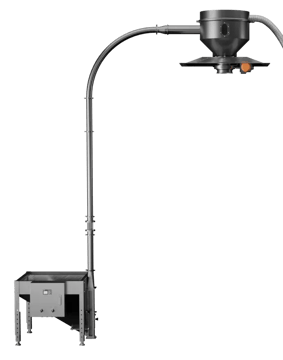
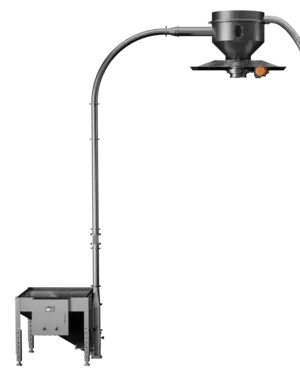
You pour coffee into a hopper on the floor. A vacuum pulls it up through a clean steel pipe. The pipe ends in a cyclone on top of your next machine. The cyclone drops the coffee into that machine.
- What it moves: green or roasted whole beans. It does not move ground coffee. For green coffee, you need the SOVDA Vacuum Box.
- Where it goes: into a roaster, a color sorter, a filler, a blender, a destoner or a silo. Is your machine not made by SOVDA? We make a plate so the cyclone fits on top.
- How fast: up to 1,000 kg (2,200 lb) of green coffee per hour. Up to 500 kg (1,100 lb) of roasted coffee per hour. It depends on your setup and your pipe.
- How far: it depends on your room. Ask us, and we will check how high and how far your Lift can go. For long or tall runs, we suggest the SOVDA Vacuum Box.
- Kind to roasted beans: with the right settings and pipe, very few beans break. We help you set both up.
- Catches metal: each hopper has a strong magnet. It catches metal, like a screw, before it gets to your next machine.
- Green or roasted: we suggest one Lift for each. If one Lift does both, you have to clean it each time you switch.
Pick your hopper
The hopper is where your team pours the coffee. Pick it by the size of your roaster's drum.
- 60 L Hopper (comes with every Lift): for roasters up to 35 kg (77 lb). It fits most roasteries.
- 150 L Hopper: for roasters from 35 to 70 kg (77–154 lb). A full 60 kg (132 lb) sack of green coffee fits in it.
- 230 L Hopper: for roasters over 70 kg (154 lb), up to 125 kg (276 lb). It holds about 120 kg (265 lb). That depends on the coffee.
- Mini Hopper with Sensors (25 L): the smallest one, for tight spaces. Sensors come built in.
- Lance: a wand that pulls coffee right out of a sack, bin or bucket. You do not need a hopper. You can have a lance, a hopper, or both.
Think about height. The 150 L and 230 L hoppers are taller than the 60 L. How will you pour into them? Maybe right from your cooling tray. Maybe by tipping a sack. We will help you plan it.
We recommend: pick by drum size. Do you plan to get a bigger roaster in the next year or two? Then pick for that one. You can swap your hopper later, too.
Upgrades
Each upgrade takes one more job off your team. Here is what each one does.
Destoner
The Destoner sits in your Lift hopper. Air lifts the roasted beans up. Stones are heavier, so they fall into a trap. You empty the trap now and then. Your coffee gets destoned while it moves. You do not need one more machine or one more step.
- Why it matters: one stone can break a grinder. It could be yours or your customer's. And it is a stone in food you sold. That can mean a broken tooth, an angry customer and a hit to your name.
- Small add, big win: it takes no floor space and no extra time.
- Have a destoner already? We still suggest it. Two are better than one. A stone that gets past the first one gets caught by the second.
- Metal, too: each hopper has a magnet. So you catch stones and metal.
- Roasted coffee only. Green beans are too heavy for the air to pull them away from stones.
We recommend: a Destoner on every Lift that carries roasted coffee to a sorter, a filler or a grinder.
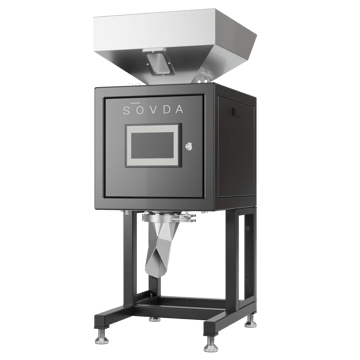
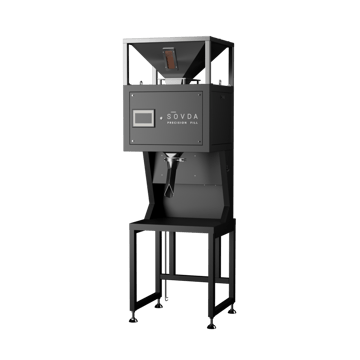
Precision Hopper (scale built in)
The Precision Hopper has a scale inside. It shows you how much coffee is in it right now, down to 2 g. It comes in 60 L and 150 L.
- No floor scale: you weigh and load in one step. No more weighing on the floor and then climbing up to pour.
- Know your roast loss: weigh the green coffee that goes in and the roasted coffee that comes out. Then you know how much weight each batch lost. That number helps you roast the same way each time.
- Blends: weigh each coffee before it goes into the SOVDA Blend.
- Stock: know how much green coffee you used, batch by batch.
We recommend: a Precision Hopper on the Lift that fills your roaster. It takes the place of the floor scale you use for each batch.
Sensors
Sensors let your Lift run on its own. There are two. You can use one or both.
- Hopper sensor (starts and stops): the Lift starts when coffee goes in the hopper. It stops when the hopper is empty. A timer makes sure the last beans go through.
- Full sensor (stops): the Lift stops when the next machine is full. So it can't overfill your sorter, filler or roaster.
- No sensors? Then the Lift runs on timers. You set how long it loads (TH) and how long it drops (TL) each time.
We recommend: both sensors on any Lift you fill many times a day. For example, under a cooling tray or at a packing station. Your team pours and walks away.
Double Hopper: two hoppers, one machine
The Double Hopper adds a second hopper. Both feed the same machine. You pick which one to pull from on the control box.
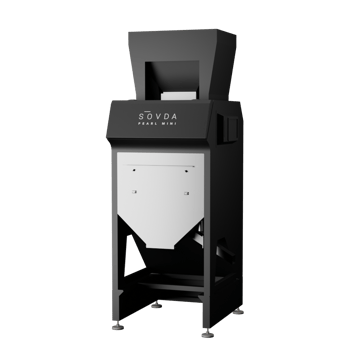
- Common setup: two roasters feed one Pearl Mini color sorter.
- What you save: a second Lift. The two hoppers share one cyclone and one vacuum.
Double Cyclone: one hopper, two machines
The Double Cyclone adds a second cyclone. Now one hopper can send coffee to two machines. You pick where it goes on the control box.
- Common setups: one hopper feeds your color sorter or your filler. Or one hopper feeds two packing lines, like two Precision Fill machines.
- What you save: a second hopper, a second vacuum and a second Lift.
Double Hopper or Double Cyclone? Does coffee come from two places into one machine? Pick the Double Hopper. Does coffee go to two machines from one place? Pick the Double Cyclone. One Lift can't have both. Two hoppers and two machines means two Lifts.
SOVDA Vacuum Box
Each Lift comes with a basic vacuum for roasted coffee. It is small and costs less. It runs on 120 V, 60 Hz (North America) or 220 V, 50 Hz (other places). The SOVDA Vacuum Box is the strong upgrade. You need it for green coffee. We suggest it for most roasted coffee Lifts, too.
- Needed for green coffee: green beans are heavier than roasted beans. They need a stronger pull.
- Much quieter: you will hear the difference. It matters most if guests visit your roastery.
- Fine control: a dial (VFD) lets you set the pull just right for your coffee and pipe. The right setting also means fewer broken roasted beans.
- Faster than the basic vacuum.
- Cleaner air: less dust goes back into your room.
- Lasts longer: made to run all day, with lots of coffee.
- Easy care: the filter is quick to clean.
- Power: 220–240 V, 50/60 Hz single phase, 2.4 kW. Each Lift needs its own Vacuum Box.
We recommend: a Vacuum Box on every Lift that moves green coffee, since it is needed there. Also get one if your Lift runs all day, moves a lot of coffee, has a long or tall pipe, or works where noise matters.
Plan your setup
Your pipe
The pipe comes in parts that clip together with Tri-Clamps in minutes. You can buy extra pipe by the metre. To plan it:
- Measure from the floor to the top of the next machine's hopper.
- Measure how far it is from your hopper to that machine.
- Write down what is in the way, like beams, doors and paths people walk.
- Is the machine not made by SOVDA? Measure the top of its hopper. We make a plate so the cyclone fits.
Send us these numbers. We will plan the layout with you. You can find layout files (PDF and DWG) on the SOVDA Lift page.
Example setups
- Green coffee into a 45 kg (99 lb) roaster: a 150 L Precision Hopper with both sensors and the SOVDA Vacuum Box. Plus a plate made to fit your roaster.
- Roaster to color sorter: a 60 L hopper with the Destoner and sensors. It feeds the Pearl Mini.
- Two roasters, one sorter: a Double Hopper that feeds the Pearl Mini. Add the Destoner and the SOVDA Vacuum Box.
- Packing: a 60 L hopper with sensors and a Double Cyclone. It feeds two Precision Fill or Precision Fill Mini machines.
Setup, wait time and paying
- Setup: two people can set up a Lift in under 2 hours. The pipe clips together. Our step-by-step guides show you how.
- Move it later: if you change your room, you can move your Lift or set it up a new way.
- Wait time: up to 150 days from order to delivery. Most of the time it is much faster, since we often have it in stock. See Shipping & Import.
- Paying: see Payment Options. Big orders can be split into parts.
The bottom line
Does your team lift heavy coffee each day? A Lift makes that work safer and faster. Pick your hopper by drum size. Add the Destoner to any Lift that carries roasted coffee. Add Sensors so your team can walk away. Get the SOVDA Vacuum Box for green coffee, where you need it. Get it too if you want quiet, all-day use. You can add each upgrade later. So buy for the roastery you run today, and add more as you grow.
FAQ
Is a Lift only for big roasteries? No. It depends on your batch size. Do you roast more than 10 batches over 8 kg (18 lb) on any day? Then a Lift will save your team a lot of heavy lifting.
Can I use the Lift with the machines I have? Yes. It fits on roasters, color sorters, fillers, destoners and silos. We make a plate to fit. We just need the size of the hopper it will sit on.
Which hopper size do I need? Pick by your roaster's drum size. The 60 L is for roasters up to 35 kg (77 lb). The 150 L is for 35–70 kg (77–154 lb). The 230 L is for roasters over 70 kg (154 lb), up to 125 kg (276 lb).
Does the Lift break roasted beans? With the right settings and pipe, very few beans break. We help you set up both. The dial on the SOVDA Vacuum Box lets you fine-tune the pull.
Is it hard to set up? No. Two people can set up a Lift in under 2 hours. You can move it or change it later.
Can one Lift feed two machines? Yes, with the Double Cyclone. To feed one machine from two hoppers, pick the Double Hopper. You pick the hopper or the machine on the control box.
Will the Lift overfill my machine? Not with Sensors. The full sensor stops the Lift when the next machine is full.
Do I need the Destoner if my roaster has one? We suggest it. It is a small add that gives you a second guard against stones. It works on roasted coffee only.
Can the Lift move green coffee? Yes, with the SOVDA Vacuum Box. You need it for green coffee. A 150 L or 230 L hopper takes a full sack. A Precision Hopper weighs your coffee as it fills your roaster.
Can one SOVDA Vacuum Box run more than one Lift? No. Each Lift needs its own vacuum.
Can the Lift move ground coffee? No. The Lift is made for green or roasted whole beans.
Can I add upgrades later? Yes. You can add the Destoner, Sensors, Precision Hopper and bigger hoppers later.
Not sure which setup fits your roastery? Talk to our team. Tell us your roaster size, what you move and where. We will plan your Lift with you.
See how it works →
Get the next lesson
One short email a week on running a leaner roastery.
Protected by reCAPTCHA. Google's Privacy Policy and Terms of Service apply.